
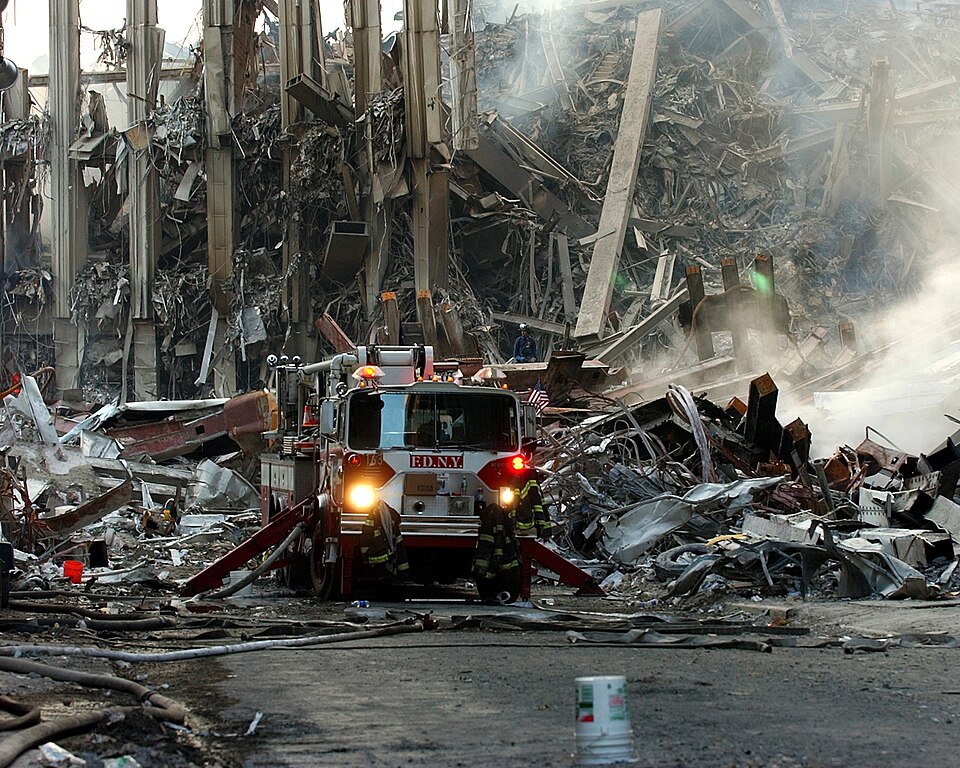
 As my career as a first responder progresses, and as I learn to see more of the “bigger picture” of incident command, I have become increasingly interested in the historical context of major incidents. We learn the Incident Command System as an organized method of establishing command, assigning operational responsibilities, controlling span of control, staging resources, maintaining communications and accountability, and expanding an organization as an incident becomes more complex. Under normal circumstances, there is always somebody in command, or at least somebody designated to assume command if the person above them becomes unavailable. September 11, 2001 presents an unusual case study because the incident did not simply overwhelm the command structure. The physical destruction caused by the collapse of the World Trade Center directly affected the people, locations, communications systems, and resources through which command itself was being exercised.
Examining what happened to incident command that morning is particularly relevant to modern first responders because many of the concepts emphasized in contemporary ICS and NIMS training are easier to understand when placed in historical context. Unified command, redundant communications, protected command posts, personnel accountability, resource tracking, staging, span of control, and succession of command can sometimes seem unnecessarily formal during routine incidents. At the World Trade Center, deficiencies or failures in several of those areas became operational problems while the incident was still developing. When the towers collapsed, some elements of the existing command structure were physically destroyed, forcing surviving officers and responders to reconstruct command while rescue operations continued.
The Initial FDNY Response
The FDNY response began almost immediately after American Airlines Flight 11 struck the North Tower at 8:46 a.m. As the scale of the incident became apparent, increasingly senior chiefs arrived and the response escalated rapidly. Chief of Department Peter J. Ganci Jr., the highest-ranking uniformed member of the FDNY, assumed overall command. Because of falling debris and hazardous conditions immediately surrounding the towers, the primary FDNY Incident Command Post was established on the west side of West Street, while the North Tower lobby functioned as an Operations Post coordinating companies operating within that building. (McKinsey & Company; 9/11 Commission)
At 9:03 a.m., United Airlines Flight 175 struck the South Tower. Separate operations were now occurring inside two 110-story buildings while an extraordinary number of engine, ladder, rescue, squad, EMS, command, and support resources converged on lower Manhattan. The 9/11 Commission described the FDNY response during the first seventeen minutes, before the second aircraft had even struck, as the largest rescue operation in New York City’s history. More than a thousand emergency responders would eventually operate in and around the World Trade Center complex. (9/11 Commission)
The concentration of FDNY leadership at the scene was similarly extraordinary. According to the Department’s post-incident review, 26 of the 32 members of FDNY’s executive staff and staff chiefs responded to the incident area, including the Fire Commissioner, Chief of Department, Chiefs of Fire and EMS Operations, and most of the Department’s staff chiefs. More than 200 FDNY units ultimately responded. Within the first several hours, the deployment included 121 engine companies, 62 ladder companies, numerous rescue and squad resources, EMS units, and dozens of chief officers. (McKinsey & Company) This provided the incident with an enormous amount of operational experience, but it also concentrated a substantial portion of the Department’s senior leadership within the same hazardous geographic area.
Command and Accountability Before the Collapses
Even before either tower collapsed, the scale of the response was placing significant pressure on existing command-and-control systems. Hundreds of firefighters were operating throughout the World Trade Center complex, including large numbers ascending stairwells inside both towers. Chiefs were attempting to track companies and assignments through Field Communications, lobby command posts, radio traffic, runners, and other established procedures. Multiple tactical radio channels were being used, but radio propagation within the towers was unreliable, and the volume of radio traffic made effective communication increasingly difficult. The post-incident review also identified problems involving units that self-dispatched or did not consistently check into the established command structure. (McKinsey & Company; 9/11 Commission)
Accountability consequently became more difficult as the response expanded. During a conventional structural incident, command should be able to identify which companies are operating, which division or group they have been assigned to, who supervises them, and approximately where they are located. The World Trade Center presented an extreme version of that problem because hundreds of responders were entering a large vertical complex through different locations while simultaneous operations were underway in both towers and surrounding buildings.
Interagency coordination created an additional challenge. FDNY, NYPD, the Port Authority Police Department, EMS, and the New York City Office of Emergency Management were all conducting operations, but they were not operating through a fully integrated unified command. Command posts were located separately, communications systems were largely agency-specific, and information available within one organization did not necessarily reach commanders in another. The 9/11 Commission later concluded that the response lacked sufficient integration of situational awareness among FDNY, NYPD, and PAPD. (9/11 Commission)
A significant example involved observations made by NYPD aviation units. Police helicopters were able to observe changing conditions near the upper portions of the towers, but FDNY commanders did not have direct access to that information through an integrated command or interoperable communications system. The 9/11 Commission concluded that FDNY decision-making was hindered by the absence of information being gathered by NYPD aviation. (9/11 Commission) From an incident-command perspective, the important issue is that information existing somewhere within an emergency response is not necessarily useful unless there is a reliable mechanism for delivering it to the people making operational decisions.
The Collapse of the South Tower
At 9:59 a.m., the South Tower collapsed in approximately ten seconds, fundamentally changing the operational environment. The FDNY Incident Command Post on West Street was overwhelmed by the collapse and debris cloud and had to be abandoned. Field Communications was disrupted, the EMS command structure in the immediate area was scattered, and personnel throughout the exterior command area were forced to seek cover. Inside the North Tower, the lobby Operations Post was affected by dust, darkness, and debris as the collapse occurred nearby. (McKinsey & Company)
The information problem became particularly severe because many firefighters operating inside the North Tower did not initially understand what had occurred. Some interpreted the event as an explosion, an internal collapse, or another structural event affecting their own building. An FDNY marine unit positioned on the Hudson River transmitted that the South Tower had completely collapsed, but the command locations normally responsible for receiving, processing, and distributing that information had themselves been disrupted. (McKinsey & Company)
This distinction is important when examining the event through an ICS framework. FDNY was not simply experiencing excessive radio traffic or an unusually difficult span-of-control problem. Several physical components through which command was exercised had suddenly become unavailable. The Incident Command Post had been abandoned, Field Communications had been disrupted, EMS command elements had been dispersed, and senior officers did not immediately have a reliable understanding of which other commanders remained operational or where replacement command functions were being established. Radio channels were increasingly occupied by Maydays, attempts to locate missing personnel, requests for assignments, and efforts by chiefs to determine which resources remained available. EMS experienced similar difficulties, with portable radios, apparatus radios, cellular telephones, and conventional telephone systems all proving unreliable or overloaded. (McKinsey & Company)
Reestablishing Command Before the Second Collapse
Chief Ganci and surviving command personnel moved north toward the Chambers Street area and attempted to reestablish control of the incident. Once it became clear that the South Tower had completely collapsed, evacuation orders for the North Tower were transmitted and efforts were made to relocate command farther from the immediate collapse zone. Those evacuation efforts were complicated by the same communications limitations that had affected the response throughout the morning. Some firefighters received the orders, others did not, and some companies had already begun withdrawing based on their own assessment of deteriorating conditions. (McKinsey & Company; 9/11 Commission)
At approximately 10:28 a.m., the North Tower collapsed. Chief Ganci was killed, along with First Deputy Commissioner William Feehan and numerous senior FDNY officers. Among the senior operational personnel killed were Assistant Chiefs Gerard Barbara and Donald Burns and Deputy Chief Raymond Downey of Special Operations Command. Battalion chiefs, company officers, firefighters, EMS personnel, and FDNY Chaplain Father Mychal Judge were also among those lost. In total, 343 FDNY members were killed on September 11. (FDNY; McKinsey & Company)
The operational significance of these losses extended beyond the extraordinary number of casualties. Multiple levels of command had been affected simultaneously. Incident command systems depend on succession because command responsibilities must continue when an officer becomes unavailable. At the World Trade Center, however, senior leaders were not becoming unavailable sequentially in a controlled transfer of authority. Officers at several levels of the organization were being killed, injured, separated from one another, or cut off from communications within the same period of time. This made identifying who remained available to exercise command considerably more difficult than a conventional transfer-of-command process.
Command and Control After 10:28 a.m.
FDNY’s post-incident review described command and control between approximately 10:29 and 11:28 a.m. as seriously impaired. Dispatch did not have a reliable picture of which chiefs had survived, where those officers were located, what resources remained available in the various sectors, whether a functioning central Incident Command Post had been established, or definitively who was functioning as the overall Incident Commander. (McKinsey & Company)
Surviving chiefs responded by establishing command functions in the areas where they found themselves and organizing resources that could be physically identified. Firefighters and officers naturally began reporting to recognizable chief officers, and several improvised command locations developed around the incident area. Because communications remained fragmented, officers establishing these command elements were not always aware that other chiefs were simultaneously attempting to establish command elsewhere. The resulting arrangement was imperfect and temporarily produced several overlapping command structures, but it allowed basic operational control to begin reappearing before a single centralized command structure could be restored. (McKinsey & Company)
EMS experienced a similar reconstruction. Approximately ten minutes after the North Tower collapsed, several surviving senior EMS officers converged near the Embassy Suites at Vesey Street and North End Avenue. They conducted an impromptu command meeting in the hotel lobby, divided available ambulances and personnel, and began establishing new operational divisions, including activities associated with Chelsea Piers and the Staten Island Ferry Terminal. Other EMS chiefs who were unaware of those decisions because communications remained disrupted were establishing divisions elsewhere. (McKinsey & Company)
Personnel accountability became an especially difficult component of the response. Officers used radio roll calls, handwritten resource reports, battalion-level personnel checks, unit rosters, and eventually telephone calls to the homes of members who remained unaccounted for. The collapse had separated companies, destroyed apparatus, killed personnel, disrupted radio communications, and eliminated many of the normal reference points used to determine where units had been assigned. As a result, rebuilding accountability became a prolonged process rather than something that could be accomplished through a conventional roll call. (McKinsey & Company)
Restoring a Central Incident Command Post
By approximately 11:28 a.m., FDNY Dispatch designated a single Incident Command Post at West and Chambers Streets, helping consolidate the command locations that had developed independently after the collapses. The ICP remained there for much of the day before being moved closer to the incident as conditions and operational priorities changed. (McKinsey & Company)
By that point, the nature of the incident had also changed substantially. The initial operation had centered on high-rise firefighting, evacuation, rescue, EMS response, and management of a mass-casualty incident. Following the collapse of both towers, the operation became a combination of rescue, structural assessment, fire suppression, heavy rescue, medical operations, logistics, engineering, debris management, personnel accountability, and eventually recovery. Command therefore had to be rebuilt at the same time that the objectives, hazards, geographic organization, and resource requirements of the incident were changing.
FDNY also continued to have responsibility for fire protection throughout the remainder of New York City. This created a resource-management problem that is easy to overlook when studying Ground Zero in isolation. A substantial portion of the Department had responded to lower Manhattan, many units had lost personnel or apparatus, and a significant number of chief officers had been killed. Nevertheless, structure fires, alarms, medical emergencies, motor-vehicle collisions, and other routine incidents continued throughout the city. Resources therefore had to be recalled, redistributed, restaffed, and retained outside the World Trade Center operation to preserve emergency coverage elsewhere. (McKinsey & Company)
The Absence of Unified Command
One of the most significant findings of the 9/11 Commission concerned the lack of an integrated command structure among the major responding agencies. FDNY, NYPD, PAPD, EMS, and OEM each had legitimate operational responsibilities and possessed information or resources relevant to the others. Their command structures, however, remained largely separate. Command posts were geographically separated, interoperable communications were limited, and there was no comprehensive unified command through which fire, police, Port Authority, EMS, and emergency-management priorities could be coordinated within a common operational picture. (9/11 Commission)
The Commission did not conclude that a properly functioning unified command would necessarily have prevented the responder fatalities at the World Trade Center. The circumstances involved too many variables to make that claim responsibly. The Commission instead concluded that the existing Incident Command System did not adequately integrate situational awareness among the responding agencies and did not sufficiently facilitate interagency coordination. That is a more limited conclusion, but an important one. The problem was not simply that individual agencies lacked competent commanders. The problem was that several competent organizations were conducting parts of the same enormous operation without a sufficiently integrated mechanism for sharing information and coordinating decisions. (9/11 Commission)
The conditions also need to be considered when evaluating those shortcomings. The response involved two deliberately attacked 110-story buildings, tens of thousands of occupants, major structural damage, multiple fires hundreds of feet above street level, falling debris, communications problems, simultaneous evacuations, thousands of responders, and ultimately two complete high-rise collapses occurring less than thirty minutes apart. No incident-command system could have made those conditions routine. The historical value lies in examining which organizational problems became more consequential as the incident exceeded the assumptions under which existing systems normally operated.
The Pentagon Response as a Comparison
The 9/11 Commission also examined the response to the attack on the Pentagon and identified important organizational differences. The two incidents should not be treated as equivalent. The Pentagon involved a single impact site and a substantially different building configuration, casualty environment, and operational scale. Nevertheless, the National Capital Region had prior experience using the Incident Command System across multiple agencies and jurisdictions. Arlington County Fire Department established incident command shortly after the Pentagon was struck, and the expanding response incorporated local fire departments, law enforcement agencies, military organizations, federal agencies, EMS resources, and emergency-management organizations into a recognizable incident-management structure. (9/11 Commission)
The Commission concluded that the Pentagon response was generally effective in part because established interagency relationships, an existing Incident Command System, and a regional approach to emergency response were already in place. This comparison became particularly relevant to the Commission’s later recommendations. Its final report recommended nationwide adoption of ICS by emergency-response agencies and specifically emphasized unified command when multiple agencies or jurisdictions are involved. The Commission also recommended tying federal preparedness funding to the adoption and regular practice of ICS and unified-command procedures. (9/11 Commission)
Modern responders consequently train within an emergency-management environment that was significantly influenced by lessons drawn from September 11. ICS itself predates the attacks by decades, having developed from earlier fire-service incident-management systems, particularly those created in California during the 1970s. What changed after September 11 was the national emphasis on standardization and interoperability. The Homeland Security Presidential Directive establishing the National Incident Management System directed the development of a consistent nationwide approach to incident management, and NIMS subsequently incorporated ICS as its standardized incident-command structure. (Department of Homeland Security; FEMA)
What September 11 Demonstrated About Incident Command
For those of us who entered emergency services after September 11, many of these practices can seem as though they have always existed in their current form. We establish Incident Command Posts, identify divisions and groups, manage span of control, stage incoming resources, develop communications plans, track personnel, transfer command, establish unified command when necessary, and identify succession within the organization. During smaller incidents, some of those procedures can seem disproportionately formal compared with the problem being managed. September 11 provides historical context for why those systems become increasingly important as an incident expands.
Protected and redundant command locations matter because a hazard can make an Incident Command Post unusable. Succession of command matters because commanders can be injured, killed, or isolated. Accountability and check-in procedures matter because uncontrolled convergence of resources makes it increasingly difficult to determine who is operating and where. Staging matters because hundreds of independently arriving units cannot be effectively managed if they enter an incident without assignment. Interoperable communications and unified command matter because information possessed by one agency may directly affect operational decisions being made by another. Resource tracking matters because a department responding to a catastrophic incident still retains obligations outside the immediate disaster area.
The World Trade Center response also demonstrates that incident command should be understood as a set of functions rather than simply an organizational chart or physical command post. After both towers collapsed, the established structure became fragmented, but the required functions remained. Somebody still had to determine priorities, organize surviving resources, establish geographic responsibility, communicate assignments, request additional resources, account for personnel, coordinate medical operations, and maintain emergency coverage elsewhere in the city. Surviving chiefs and responders began performing those functions locally until a centralized structure could be restored.
That process is perhaps the most useful historical lesson from the incident. The formal command system was severely disrupted, but experienced personnel did not stop organizing the response simply because the existing structure had been damaged. Command elements formed around surviving officers, EMS divisions were reconstructed, resources were redistributed, accountability efforts began, and eventually those separate command elements were consolidated under a central Incident Command Post. The process was imperfect and occurred under extraordinary conditions, but it illustrates why responders are trained not only to operate within an established ICS structure, but also to establish one when none exists.
Why the History Still Matters
Studying September 11 from an incident-command perspective does not require finding a simple procedural explanation for what occurred. There isn’t one. The scale and nature of the attacks exceeded anything FDNY or the other responding agencies had previously encountered, and many of the difficulties documented afterward involved limitations in technology, interagency coordination, resource management, and command systems that had developed under very different assumptions.
What the historical record does provide is an unusually detailed example of an incident progressively stressing a command system, disrupting communications, eliminating command locations, causing mass casualties among leadership, fragmenting accountability, and requiring surviving responders to reconstruct the organization while operations continued. The subsequent investigations also provide a direct connection between problems observed that morning and the later national emphasis on standardized incident management, unified command, interoperability, and multiagency coordination.
For a modern first responder, that history makes some of the less exciting parts of ICS considerably easier to appreciate. A secondary command location, an accountability board, a designated staging area, a communications plan, a clear transfer of command, an identified successor, or an established unified command can look like administrative details when everything is working normally. Their value becomes much clearer when examining an incident in which several of those systems were simultaneously degraded or lost.
September 11 is remembered primarily, and appropriately, for the people who were killed and for the extraordinary rescue efforts undertaken that morning. Within emergency services, it should also be studied as one of the most significant command-and-control case studies in American history. The lessons documented afterward influenced how an entire generation of responders has been taught to organize large incidents, and understanding what happened provides important context for why many of those systems exist in the form they do today.
Never forget.
– Benjamin F., NR-P
Sources:
– McKinsey & Company. Increasing FDNY’s Preparedness. Fire Department of the City of New York, Aug. 2002.
– McKinsey & Company. “Emergency Medical Service Response on September 11.” Increasing FDNY’s Preparedness. Fire Department of the City of New York, 2002.
– National Commission on Terrorist Attacks Upon the United States. The 9/11 Commission Report. U.S. Government Printing Office, 2004.
– National Commission on Terrorist Attacks Upon the United States. “Heroism and Horror.” The 9/11 Commission Report, Chapter 9, 2004.
– Fire Department of the City of New York. Historical and memorial records concerning members killed on September 11, 2001.
– Department of Homeland Security. Homeland Security Presidential Directive 5: Management of Domestic Incidents. 28 Feb. 2003.
– Federal Emergency Management Agency. National Incident Management System. U.S. Department of Homeland Security.