
Water preparedness can become an enormous subject very quickly. We can talk about how much water a household should store, how long stored water remains usable, where to find water in an emergency, rainwater collection, wells, desalination, purification chemicals, boiling, and a dozen other related topics. This article isn’t intended to cover all of that. For now, I want to focus on one narrow question: if you have water available but cannot be confident that it is microbiologically safe to drink, what filtration equipment should an ordinary household actually have?
That distinction is important. A water filter does not create water, and it cannot make every contaminated water source safe. If floodwater contains fuel, pesticides, industrial chemicals, radioactive material, or other hazardous contaminants, running it through a backpacking filter does not magically turn it into drinking water. The CDC specifically warns that water contaminated with fuel, toxic chemicals, or radioactive materials cannot be made safe by boiling or ordinary disinfection and recommends using another water source instead. (Centers for Disease Control and Prevention)
What filters can do extremely well is provide another layer of preparedness when otherwise usable freshwater may contain microorganisms or suspended material. A municipal boil-water advisory, damaged water infrastructure, extended power failure affecting a well, earthquake, hurricane, flood, or other disaster can create circumstances where the water around you is considerably easier to obtain than water you are comfortable drinking. For that problem, I think there are two wonderfully simple pieces of equipment worth understanding: the Millbank bag and the Sawyer Squeeze. They perform very different jobs, and that is precisely why they work so well together.
First, Filtration and Purification Are Not the Same Thing
The terminology surrounding consumer water filters is terrible. “Filtered,” “purified,” “clean,” and “safe” are routinely used interchangeably in advertising even though they do not necessarily mean the same thing. At its simplest, filtration physically removes things from water. The effectiveness of a filter depends heavily on the size of what it can reliably remove. The CDC explains that an absolute pore size is particularly important because an absolute 1-micron filter means every pore is 1 micron or smaller, while a “nominal” or average 1-micron filter can contain larger openings. (Centers for Disease Control and Prevention)
For microorganisms, size matters. CDC emergency guidance says an absolute pore size of 1 micron or smaller can remove parasites such as Giardia and Cryptosporidium, while an absolute pore size of 0.3 micron or smaller is needed to remove bacteria. Viruses are considerably smaller and generally require other treatment methods. (Centers for Disease Control and Prevention)
This is why buying something online that merely says “water filter” tells you remarkably little. A refrigerator filter is a water filter. A Brita-style carbon pitcher is a water filter. A piece of canvas can be a water filter. A 0.1-micron hollow-fiber membrane is also a water filter. They are not interchangeable pieces of equipment. The CDC specifically notes that many common activated-carbon pitcher and refrigerator filters are primarily intended to improve taste and odor rather than make microbiologically unsafe water safe to drink. (Centers for Disease Control and Prevention) The first rule of emergency water filtration, then, is knowing what your filter actually removes.
The Millbank Bag: Almost Too Simple
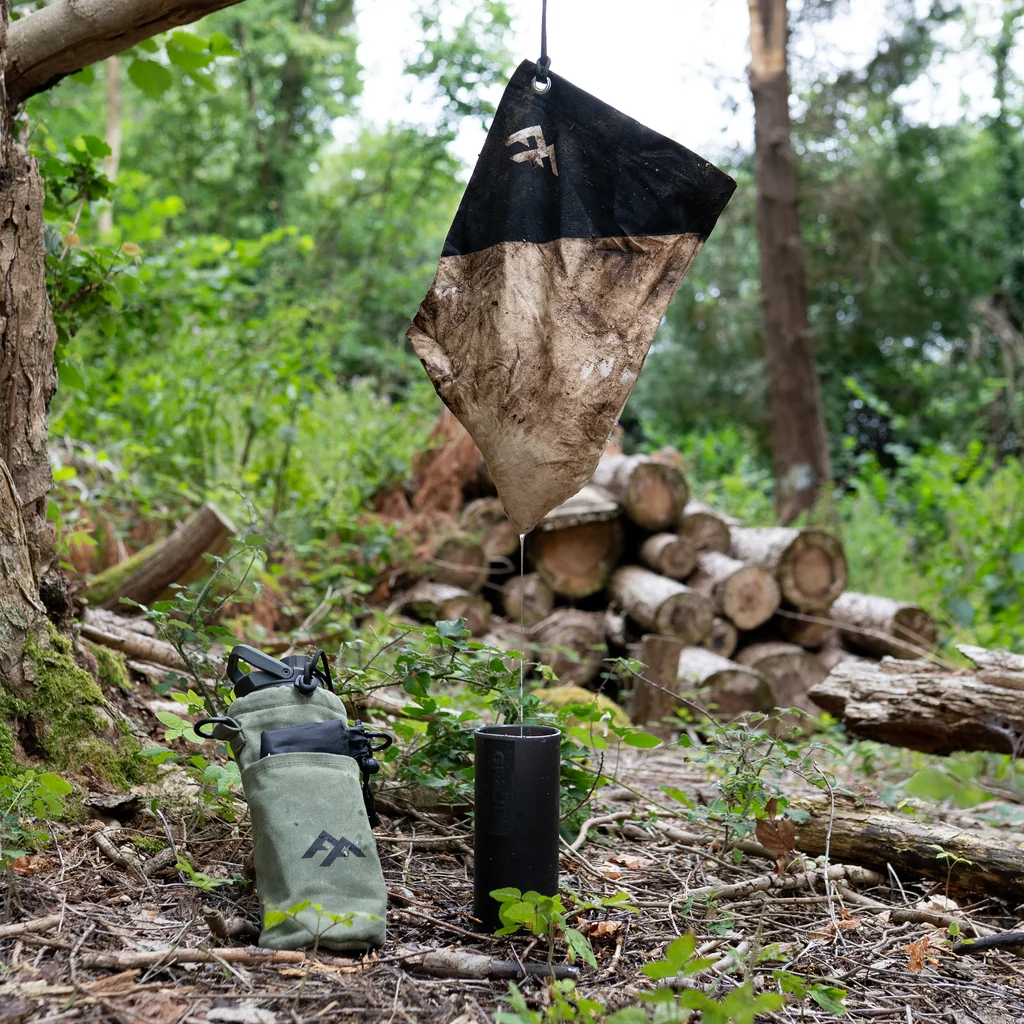
A Millbank bag almost looks too primitive to deserve the word “filter.” It is essentially a tightly woven canvas bag. You soak it, fill it with dirty water, hang it, and allow gravity to slowly pull the water through the fabric. What comes out can look dramatically better than what went in, but the important thing to understand is that it is not making that water microbiologically safe.
A Millbank bag is a prefilter. Its job is to remove suspended organic material, mud, silt, grit, insects, plant debris, and other larger particulates before the water reaches your actual treatment system. Millbank Bag USA, one American manufacturer of the traditional design, specifically describes the bag as a prefiltration device intended to remove suspended material and extend the useful life of downstream filters. (Millbank Bags USA)
That principle is also consistent with CDC and EPA emergency guidance. Both agencies recommend allowing cloudy water to settle and then passing it through a clean cloth, paper towel, or coffee filter before subsequent boiling or disinfection. (Centers for Disease Control and Prevention; U.S. Environmental Protection Agency) The Millbank bag is essentially a purpose-built, reusable version of that first step.
This matters because muddy water is hard on fine filters. A hollow-fiber membrane designed to catch microscopic organisms will also catch an enormous amount of microscopic and macroscopic sediment. The dirtier the source water, the faster flow through that filter will diminish and the more frequently it will require cleaning. Putting visibly dirty water through a coarse prefilter first means your expensive fine filter has less work to do.
There is another preparedness advantage: a Millbank bag is mechanically simple. There is no cartridge to expire, no battery, no pump mechanism, and no chemical treatment impregnated into the fabric. After use, it can be rinsed, cleaned of accumulated sediment, dried thoroughly, and stored. Commercial manufacturers recommend making sure the bag is completely dry before putting it away. (Millbank Bags USA) Just remember that water coming out of a Millbank bag is not automatically safe to drink. It may look beautifully clear and still contain disease-causing microorganisms.
The Sawyer Squeeze: Where the Real Filtration Happens
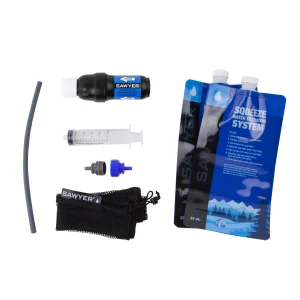
The second part of the system is almost the opposite. A Sawyer Squeeze is physically tiny, but inside it is a hollow-fiber membrane rated to an absolute pore size of 0.1 micron. Sawyer states that the Squeeze removes 99.99999 percent of bacteria including organisms such as E. coli, Salmonella, and cholera-causing bacteria, along with 99.9999 percent of protozoa such as Giardia and Cryptosporidium. Sawyer also states that it removes microplastics. (Sawyer Products)
The CDC’s independent general guidance supports the underlying filtration principle: an absolute pore size of 0.3 micron or smaller is capable of removing bacteria and parasites from water. (Centers for Disease Control and Prevention) The Sawyer’s stated 0.1-micron absolute membrane is therefore comfortably within that range.
The Squeeze is also unusually practical for emergency preparedness because it doesn’t require electricity. Water can be forced through it using the supplied pouch, it can attach to compatible 28-mm threaded bottles, and Sawyer also supports using the filter in gravity configurations. The filter can be backwashed when flow decreases rather than simply thrown away. (Sawyer Products)
Sawyer currently backs the Squeeze itself with a limited lifetime warranty, and the company emphasizes cleaning and backwashing rather than routine replacement on a calendar. Sawyer recommends backwashing when flow begins to diminish, before prolonged storage, and again when returning the filter to service after storage. (Sawyer Products) That makes it very different from an activated-carbon cartridge that you replace every few months regardless of whether it appears clogged.
There is, however, one particularly important limitation: a Sawyer Squeeze is a filter, not a universal purifier. Sawyer itself states that the Squeeze does not remove metals, pesticides, volatile organic compounds, hydrocarbons, salt, or other dissolved chemical contamination. It also is not designed to remove viruses. (Sawyer Products)
That last limitation matters because bacteria and viruses are not the same size. CDC guidance says portable filters with an absolute pore size of 0.3 micron or smaller can remove bacteria and parasites but not viruses. Where viral contamination is a meaningful concern, the CDC recommends following filtration with an appropriate disinfectant. (Centers for Disease Control and Prevention) This is one reason I dislike emergency products that simply promise “clean water” without explaining what that means. There is no single pocket-sized device that should automatically be assumed to handle every conceivable contaminated source.
Use Them in the Right Order
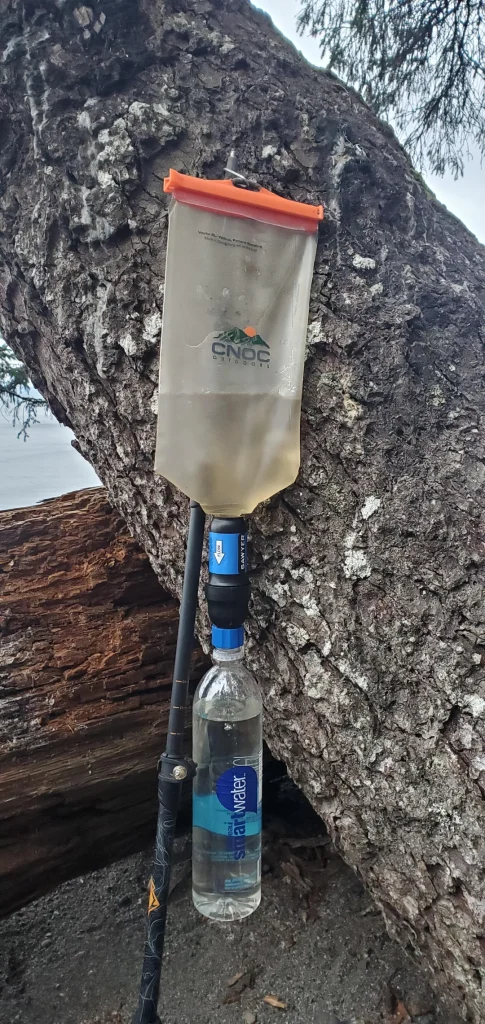
If I were putting together a basic household emergency filtration setup around these two products, the order would be straightforward. Dirty or turbid freshwater goes through the Millbank bag first, that water then goes through the Sawyer Squeeze, and if the circumstances create a meaningful viral contamination risk or public-health authorities specifically recommend disinfection, an appropriate additional disinfection step follows the manufacturer’s or public-health instructions.
The Millbank is doing the crude work. It is catching the mud, organic debris, and larger suspended particles you don’t want prematurely loading the fine membrane. The Sawyer then performs the microbiological filtration it was actually engineered to perform. In very clear source water, the Millbank may be unnecessary. There is no reason to turn water treatment into a ceremonial seven-step ritual if the source is already visually clear and the filter is appropriate for the actual hazard. But if the available water looks like chocolate milk after a storm, sending it directly into your fine filter is asking that filter to perform two jobs when a cheap piece of canvas could have handled the first one.
The same basic principle applies even if you don’t own a Millbank bag. CDC and EPA guidance recommends settling cloudy water and passing it through a clean cloth, paper towel, or coffee filter before further treatment. (Centers for Disease Control and Prevention; U.S. Environmental Protection Agency) The objective isn’t complicated equipment. It is simply staged treatment, using a coarse filtration step when necessary before asking a much finer filter to do its job.
Clear Water Does Not Mean Safe Water
This deserves its own discussion because human beings are remarkably susceptible to judging water with our eyes. Clear water feels safe and dirty water feels dangerous, but microorganisms don’t care what the water looks like. A crystal-clear mountain stream can contain Giardia. Water coming from a damaged municipal system may look exactly the way it did yesterday. Conversely, visibly cloudy water may become perfectly usable after appropriate treatment if its problem is suspended sediment and microorganisms rather than chemical contamination.
Appearance tells you something about water, but it does not tell you everything. This is why emergency filtration should be based on the likely contamination rather than whether the finished product looks refreshing.
If authorities issue a boil-water advisory, follow the advisory. If officials say a water source may contain chemical contamination, do not substitute a Sawyer for that warning. If the CDC or local health department recommends boiling, boil it. CDC continues to describe boiling as the best method for killing germs in emergency water, recommending a rolling boil for one minute, or three minutes above 6,500 feet. (Centers for Disease Control and Prevention) A filter is a tool, not permission to ignore public-health information.
The Amazon Problem
There is another issue with water filtration that I think deserves considerably more attention in preparedness circles: counterfeit and falsely advertised filters. This is one category where saving twelve dollars by buying the mysterious alphabet-soup brand is a particularly bad gamble.
Sawyer has publicly documented counterfeit Sawyer filters. The company warns that counterfeit units can look virtually identical to authentic products and states that it cannot verify their technical performance or quality. Sawyer has previously worked with Amazon regarding affected counterfeit products and specifically recommends purchasing through authorized sources. (Sawyer Products)
This is not merely theoretical or ancient history. NSF, the independent organization responsible for widely used water-treatment certification standards, continues to publish public notices regarding water filters advertised online with unauthorized NSF certification claims. In 2026 alone, NSF published notices involving products sold through Amazon that claimed NSF certification or displayed NSF documentation despite the products not actually being certified. (NSF)
That should make anyone buying emergency water equipment stop for a moment. With a fake flashlight, you discover fairly quickly that you bought a bad flashlight. A fake microbiological filter can produce perfectly clear water while failing to provide the protection you thought you purchased, and you may not discover the failure until gastrointestinal symptoms begin days later. That is a fundamentally different kind of product failure.
For something responsible for making questionable water drinkable, I would buy directly from the manufacturer or from a well-established outdoor retailer rather than selecting whichever marketplace listing is cheapest. For a Sawyer, the simplest option is buying directly from Sawyer Products or from an established outdoor retailer such as REI Co-op. For a traditional Millbank-style prefilter, buy from a known manufacturer or established outdoor retailer and understand that you are buying a prefilter, not a microbiological purifier.
Amazon itself is not inherently the problem. Marketplace ambiguity is. Seller identity, fulfillment source, copied product photographs, fake certification marks, and counterfeit packaging can make it difficult for an ordinary buyer to know what actually arrived. If you do purchase a safety-critical filter through a marketplace, verify the seller, compare the product and packaging against the manufacturer’s current information, retain proof of purchase, and verify certification claims independently rather than trusting a logo printed in a product photograph. The CDC specifically recommends using NSF’s certification database when evaluating filters that claim NSF certification. (Centers for Disease Control and Prevention) For emergency water, “probably genuine” isn’t a standard I particularly like.
Shelf Life Is More About Maintenance Than a Date
Emergency equipment creates another predictable problem: we buy it, put it in a tote, and rediscover it eight years later. With hollow-fiber filters, there is not necessarily a simple expiration date printed on the cartridge. Sawyer lists the Squeeze as supported by its limited lifetime warranty and designs it to be repeatedly backwashed. That does not mean you should buy one, throw it unopened into a garage until 2041, and assume everything is fine. (Sawyer Products)
Treat filtration equipment like equipment. Take it out periodically. Inspect the pouches, hoses, caps, O-rings, connectors, and filter housing. Make sure you still have the cleaning equipment. Read the current instructions. If it has been used, clean and backwash it according to the manufacturer’s directions before long-term storage. Sawyer specifically recommends backwashing before prolonged storage and again when putting the filter back into service. (Sawyer Products)
There is another major issue with hollow-fiber filters: freezing. Once a hollow-fiber filter has been wetted, trapped water can freeze and potentially damage the fibers. Damage may not necessarily be visually obvious afterward. Follow the manufacturer’s cold-weather instructions and do not assume a previously frozen wet filter remains trustworthy merely because water still flows through it. For a household emergency kit, I would therefore keep the filtration system somewhere reasonably climate-controlled rather than forgotten in a vehicle through years of hard freezes and summer heat.
The Millbank bag is simpler. Clean it after use, remove accumulated sediment, allow it to dry completely, and store it dry. Inspect it periodically for damage, contamination, mildew, or deterioration. I wouldn’t establish an arbitrary schedule where a perfectly functional Sawyer gets thrown away every two years. I would establish a check schedule. Once or twice a year, when you inspect the rest of your emergency equipment, inspect the water system too. If there is any doubt about the integrity of a safety-critical filter, replace it. The cost of a replacement is trivial compared with discovering that your emergency drinking-water plan depended on damaged equipment.
What I Would Actually Keep at Home
For a normal household, I don’t think emergency filtration needs to become an expensive collection of pumps, ultraviolet sterilizers, ceramic filters, straws, chemical treatments, and countertop contraptions. I would rather have a simple system I understand.
A genuine Sawyer Squeeze provides an excellent primary portable microfilter for bacteria and protozoa. A Millbank bag or another legitimate coarse prefilter gives you a reusable way to deal with ugly, sediment-heavy water before it reaches the Sawyer. The Sawyer’s backwashing equipment should stay with the filter rather than disappearing into a kitchen drawer. A clean collection container should be part of the setup so treated water does not immediately become recontaminated by the same dirty container used to collect it.
I would also keep an appropriate secondary disinfection option available because no 0.1-micron backpacking filter should be treated as universal protection against every biological hazard. CDC guidance specifically recommends adding chemical disinfection after portable filtration when viral contamination is a concern. (Centers for Disease Control and Prevention) That gives you a layered system without turning your garage into a municipal water-treatment plant and also provides some useful redundancy. If water is already clear, use the Sawyer. If it is filthy, prefilter it first. If the microbiological risk includes viruses, add the appropriate disinfection step. If officials warn of chemical, fuel, or radioactive contamination, stop trying to solve the problem with these tools and use a different water source. Different problems require different answers.
The Filter You Own Should Not Be a Mystery
This is ultimately the part of emergency water preparedness I think matters most: don’t wait for the water system to fail before opening the package. Run some ordinary tap water through your Sawyer. Learn how the pouch attaches. Learn how much pressure is reasonable. Learn how to backwash it. Set up the Millbank bag and watch how slowly gravity actually works. Figure out which container you are going to collect water in. Keep the pieces together. Read the manufacturer’s instructions while you have internet access and nothing is going wrong.
A water filter is not particularly complicated equipment, but the middle of an emergency is a poor time to discover that you don’t understand yours. This is also why I prefer established equipment over a box containing twelve mysterious “survival straws” purchased for $19.99. The objective isn’t to own the largest number of filters. The objective is to own equipment with known performance, understand its limitations, maintain it properly, and know exactly how it fits into your plan.
Water filtration is only one part of water preparedness. It does not answer where your water will come from, how much your household should store, or how long you could function without normal utility service. Those are separate conversations worth having. This discussion is simpler: if questionable freshwater is what you have, remove the junk first, use a legitimate filter appropriate for the microorganisms you’re concerned about, add disinfection when the hazard requires it, never assume a filter removes chemicals or viruses unless its actual specifications say that it does, buy safety-critical equipment from sources you trust, and learn how to use it before you need it.
A Millbank bag and a genuine Sawyer Squeeze aren’t particularly exciting pieces of preparedness equipment, and that’s probably part of why I like them. They’re simple, reusable, understandable, and each does one job well. Just make sure you know which job that is.
Stay hydrated my friends,
– Benjamin F., NR-P
Sources:
– Centers for Disease Control and Prevention. “How to Make Water Safe in an Emergency.” CDC, 2024.
– Centers for Disease Control and Prevention. “About Choosing Home Water Filters.” CDC, 2024.
– Centers for Disease Control and Prevention. “About Water Treatment Options When Hiking, Camping, or Traveling.” CDC, 2025.
– Centers for Disease Control and Prevention. “About Home Water Treatment Systems.” CDC, 2024.
– U.S. Environmental Protection Agency. “Emergency Disinfection of Drinking Water.” EPA, 2026.
– Sawyer Products. “Squeeze Water Filter System.” Sawyer Products, accessed 6 Sept. 2026.
– Sawyer Products. “Squeeze Water Filter: Product Help and Maintenance.” Sawyer Products, accessed 6 Sept. 2026.
– Sawyer Products. “Counterfeit Sawyer Products: How to Spot Fakes.” Sawyer Products, accessed 6 Sept. 2026.
– Sawyer Products. “Lifetime Warranty.” Sawyer Products, accessed 6 Sept. 2026.
– NSF. “Renami: Unauthorized Distribution of an NSF Certificate.” NSF Public Notices, 11 Mar. 2026.
– NSF. “Fenxixdy: Unauthorized NSF Mark and Certification Claims.” NSF Public Notices, 26 Mar. 2026.
– NSF. “Bogda on Amazon.com: Unauthorized NSF Certification Claims.” NSF Public Notices, 1 Nov. 2024.
– Millbank Bags USA. “Millbank Bag U.S.A.: A Water Pre-Filtration Bag.” Accessed 6 Sept. 2026.